
Insurance is designed to protect individuals and businesses from financial loss, but not all insurance policies operate under the same regulatory fram
Last Updated on December 23, 2025 by Asad Saad
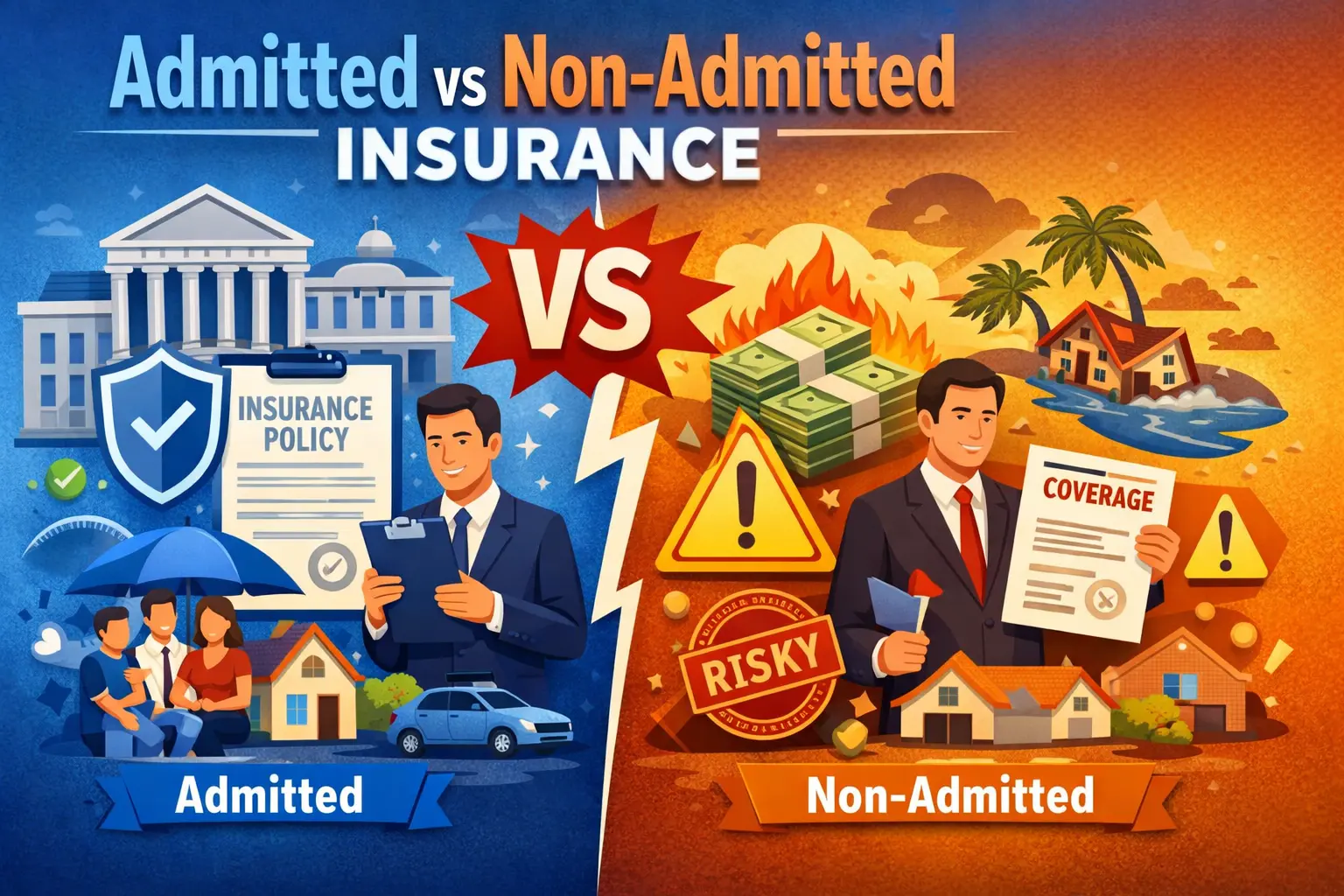
Insurance is designed to protect individuals and businesses from financial loss, but not all insurance policies operate under the same regulatory framework. One of the most misunderstood distinctions in the insurance world is the difference between admitted and non-admitted insurance. While both types serve legitimate purposes and are widely used, they differ significantly in terms of regulation, consumer protection, flexibility, pricing, and risk exposure. Understanding these differences is essential for policyholders, business owners, risk managers, and even insurance professionals who want to make informed decisions rather than relying on assumptions or incomplete advice.
At a high level, admitted insurance refers to coverage provided by insurers that are licensed and regulated by a specific state or jurisdiction, whereas non-admitted insurance comes from insurers that are not licensed in that state but are legally allowed to operate under surplus lines regulations. Although this distinction sounds technical, it has very real consequences when it comes to claim payments, policy terms, regulatory oversight, and financial guarantees. Choosing between admitted and non-admitted insurance is not about which option is “better” in general, but rather which option is more appropriate for a specific risk profile, industry, or coverage need.
This guide explores admitted vs non-admitted insurance in depth, covering definitions, regulatory frameworks, financial protections, pricing differences, real-world use cases, advantages, disadvantages, and common misconceptions. By the end, you will have a clear and practical understanding of how these insurance types work and when each one makes sense.
Table of Contents
- What Is Admitted Insurance?
- What Is Non-Admitted Insurance?
- Regulatory Oversight and Legal Framework
- Financial Protection and Guaranty Funds
- Policy Flexibility and Coverage Customization
- Pricing Differences and Market Dynamics
- Common Use Cases for Admitted Insurance
- Common Use Cases for Non-Admitted Insurance
- Advantages of Admitted Insurance
- Advantages of Non-Admitted Insurance
- Key Risks and Considerations
- Misconceptions About Non-Admitted Insurance
- How to Choose Between Admitted and Non-Admitted Insurance
- Final Thoughts
What Is Admitted Insurance?
Admitted insurance is coverage provided by insurance companies that are licensed, approved, and regulated by a state’s insurance department. These insurers must comply with all state laws, including rate approvals, policy form approvals, solvency requirements, consumer protection rules, and ongoing financial reporting obligations. Because admitted insurers operate under strict regulatory oversight, they are generally considered more stable and predictable from a consumer protection standpoint.
One of the most important features of admitted insurance is that it comes with access to the state guaranty fund. If an admitted insurer becomes insolvent and is unable to pay claims, the guaranty fund may step in to cover eligible claims up to certain limits. This safety net provides an added layer of protection for policyholders, particularly individuals and small businesses that may not be able to absorb unexpected losses.
Admitted insurers must also use policy forms and coverage language that have been reviewed and approved by regulators. This reduces the likelihood of unfair exclusions, ambiguous terms, or unexpected limitations buried deep within the policy. While this oversight can sometimes limit flexibility, it also creates consistency and transparency, making it easier for consumers to understand what they are buying and what protections they can reasonably expect.
What Is Non-Admitted Insurance?
Non-admitted insurance, also known as surplus lines insurance, is coverage provided by insurers that are not licensed in the policyholder’s state but are permitted to write business under specific surplus lines laws. These insurers are typically used when coverage cannot be obtained from admitted carriers, either because the risk is too high, too unusual, or too specialized.
Unlike admitted insurers, non-admitted insurers are not required to file rates or policy forms with state regulators. This gives them significantly more flexibility in designing coverage, pricing policies, and responding quickly to emerging or complex risks. For industries such as construction, oil and gas, technology, cannabis, aviation, or special events, non-admitted insurance is often the only viable option.
However, non-admitted insurance does not come with access to state guaranty funds. If a non-admitted insurer becomes insolvent, policyholders generally have no guaranteed recourse through state protection programs. For this reason, surplus lines insurers are typically required to meet higher financial strength standards and are often well-known global carriers with strong balance sheets.
While non-admitted insurance may appear to be a secondary option, it exists for critical reasons tied to risk complexity, regulatory constraints, and market capacity limitations. Many businesses and industries are placed into surplus lines coverage not by preference, but because admitted insurers are structurally unable to insure certain exposures. A deeper explanation of why certain risks are placed in non-admitted insurance markets helps clarify how underwriting limitations, emerging risks, and regulatory frameworks influence coverage availability.
Regulatory Oversight and Legal Framework
The regulatory difference between admitted and non-admitted insurance is one of the most critical distinctions. Admitted insurers are directly regulated by the state insurance department, which oversees everything from premium rates to claims handling practices. Regulators have the authority to investigate complaints, impose penalties, and even revoke licenses if an insurer fails to meet legal or financial obligations.
Non-admitted insurers, on the other hand, are regulated indirectly. While they are not licensed in the state, surplus lines brokers must ensure that these insurers meet eligibility requirements, such as minimum capital and surplus levels. In the United States, surplus lines insurers are often regulated at their home jurisdiction and may also be listed on approved surplus lines insurer lists maintained by individual states.
For additional regulatory background, you can refer to the National Association of Insurance Commissioners (NAIC), which provides comprehensive resources on insurance regulation and surplus lines frameworks:
https://content.naic.org
Financial Protection and Guaranty Funds
One of the most commonly cited advantages of admitted insurance is access to state guaranty funds. These funds are designed to protect policyholders if an admitted insurer becomes insolvent, covering unpaid claims up to statutory limits. This protection can be especially important for personal lines of insurance, such as homeowners or auto coverage, where individuals may not have the financial capacity to absorb losses.
Non-admitted insurance does not offer this protection. While this may sound alarming, it is important to understand that surplus lines insurers are often financially strong companies that specialize in complex or high-risk coverage. In many cases, the absence of a guaranty fund is offset by higher underwriting standards, more conservative pricing, and specialized expertise in managing unique risks.
Still, policyholders should be fully aware of this difference and factor it into their risk management decisions, particularly for large or mission-critical exposures.
The distinction between admitted and non-admitted insurance becomes most significant during claims and insurer insolvency events. Consumer protections, financial backstops, and regulatory remedies vary widely between these markets, directly affecting how losses are handled in real-world scenarios. A detailed breakdown of claims handling, consumer protection, and financial security in admitted versus non-admitted insurance provides essential clarity on where regulatory safeguards apply and where policyholders assume greater responsibility.
Policy Flexibility and Coverage Customization
Admitted insurance policies are standardized to a significant degree because they must use regulator-approved forms. This standardization is beneficial for transparency and fairness, but it can limit the insurer’s ability to customize coverage for unusual risks. As a result, admitted policies may include exclusions or limitations that leave certain exposures uninsured.
Non-admitted insurance excels in flexibility. Because surplus lines insurers do not need prior approval for policy forms, they can tailor coverage to fit highly specific needs. This flexibility allows insurers to craft policies that address emerging risks, unconventional business models, or one-of-a-kind operations that admitted carriers are unwilling or unable to insure.
This is why non-admitted insurance is often used for cyber liability, environmental liability, professional liability for niche professions, and high-risk property exposures.
Pricing Differences and Market Dynamics
Pricing is another area where admitted and non-admitted insurance differ significantly. Admitted insurers must file their rates with regulators, which can slow down pricing adjustments and limit responsiveness to market changes. While this protects consumers from sudden or excessive rate hikes, it can also result in admitted insurers withdrawing from certain markets when risks increase rapidly.
Non-admitted insurers have greater freedom to price policies based on real-time risk assessments. This often results in higher premiums for high-risk exposures, but it also ensures that coverage remains available when admitted markets tighten or exit altogether. In hard insurance markets, where capacity is limited, non-admitted insurance plays a critical role in maintaining coverage availability.
Common Use Cases for Admitted Insurance
Admitted insurance is most commonly used for standard, predictable risks that fall well within established underwriting guidelines. Personal auto insurance, homeowners insurance, standard commercial property insurance, and workers’ compensation are typically written through admitted carriers. These risks are well understood, loss data is widely available, and regulatory oversight ensures consistent consumer protection.
For individuals and small businesses with relatively straightforward insurance needs, admitted insurance is often the preferred option due to its stability, transparency, and guaranty fund protection.
Common Use Cases for Non-Admitted Insurance
Non-admitted insurance is frequently used for risks that are considered too volatile, specialized, or high-severity for admitted markets. This includes industries such as construction with high hazard exposure, entertainment and event production, aviation, marine operations, and emerging sectors like cryptocurrency or cannabis businesses.
It is also commonly used when an admitted insurer declines coverage, either due to underwriting restrictions or market capacity limitations. In these situations, surplus lines insurance provides a necessary and legal alternative rather than leaving the risk uninsured.
Advantages of Admitted Insurance
Admitted insurance offers strong consumer protections, predictable policy language, regulatory oversight, and access to guaranty funds. These features make it an excellent choice for standard risks and for policyholders who prioritize stability and regulatory safeguards. Claims handling processes are also more standardized, which can reduce disputes and delays.
Advantages of Non-Admitted Insurance
Non-admitted insurance offers unmatched flexibility, faster market response, and access to coverage for risks that admitted insurers cannot or will not insure. It allows businesses to operate in high-risk or innovative industries without being constrained by rigid underwriting rules. For many organizations, surplus lines insurance is not a fallback option but a strategic necessity.
Key Risks and Considerations
While both insurance types are legitimate, each comes with trade-offs. Admitted insurance may lack the flexibility needed for complex risks, while non-admitted insurance requires careful due diligence due to the absence of guaranty fund protection. Policyholders should work with knowledgeable brokers who understand both markets and can explain policy terms clearly.
For further educational insight into surplus lines insurance, the Insurance Information Institute provides a helpful overview.
Misconceptions About Non-Admitted Insurance
A common misconception is that non-admitted insurance is illegal or unsafe. In reality, surplus lines insurance is a regulated and essential part of the insurance ecosystem. It exists precisely to address gaps left by admitted markets and is used by many large corporations and institutions.
Another misconception is that non-admitted insurance always costs more. While premiums can be higher due to increased risk, the value lies in the coverage itself. Paying less for inadequate coverage can ultimately be far more expensive.
How to Choose Between Admitted and Non-Admitted Insurance
The choice between admitted and non-admitted insurance should be based on risk characteristics, coverage needs, regulatory requirements, and financial tolerance. Standard risks with predictable loss profiles typically fit well within admitted markets, while complex or high-risk exposures often require surplus lines solutions.
Consulting with an experienced insurance professional who understands both markets is essential to making an informed decision.
Final Thoughts
Admitted vs non-admitted insurance is not a question of right or wrong, but of suitability and risk alignment. Both play vital roles in the insurance industry and serve different but equally important purposes. Understanding the differences empowers policyholders to make strategic decisions, avoid coverage gaps, and ensure financial protection aligned with their real-world risks.
By approaching insurance as a risk management tool rather than a commodity, individuals and businesses can better navigate the complexities of modern insurance markets and choose coverage that truly meets their needs.

COMMENTS