
Understanding the Structure of Insurance Markets Insurance markets are not designed to insure every possible risk equally. Admitted insurance markets
Last Updated on December 23, 2025 by Asad Saad
Table of Contents
- Understanding the Structure of Insurance Markets
- Market Capacity Constraints and Withdrawal of Admitted Insurers
- Unique and Non-Standard Business Operations
- Regulatory Limitations on Policy Design
- High-Severity, Low-Frequency Risks
- Legal and Litigation Environment Pressures
- Oversight of Non-Admitted Insurance Markets
- Why Non-Admitted Insurance Is Essential
Understanding the Structure of Insurance Markets
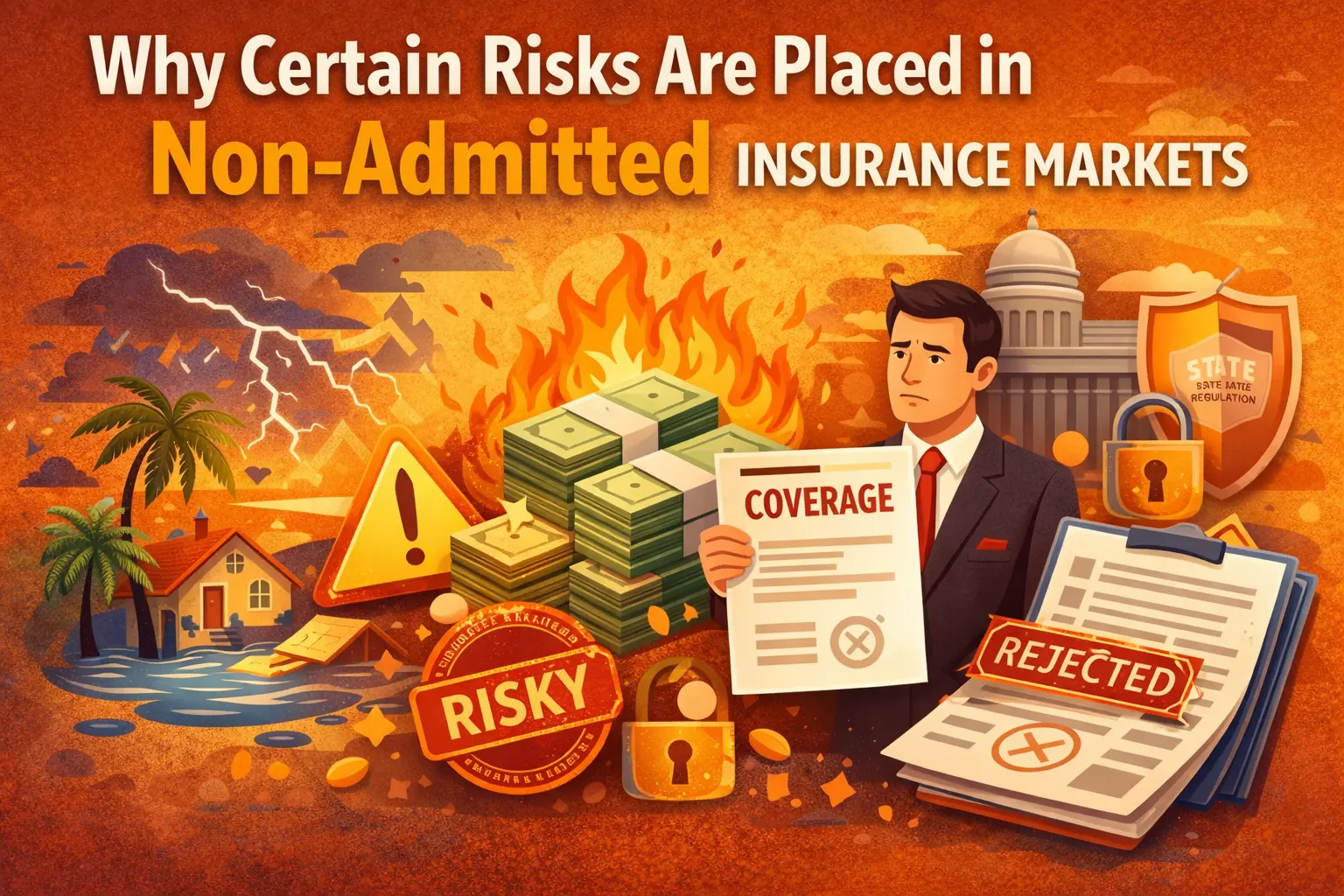
Insurance markets are not designed to insure every possible risk equally. Admitted insurance markets rely on predictability, actuarial data, and regulatory approval to function effectively. When risks fall outside these boundaries—due to severity, volatility, novelty, or legal uncertainty—coverage becomes difficult or impossible to place with admitted insurers. This structural limitation is not a failure of admitted insurance but a reflection of its purpose: to provide stability for standard, measurable risks. Non-admitted insurance exists specifically to absorb risks that cannot be standardized without threatening insurer solvency or regulatory compliance.
Admitted insurers must justify every rate and coverage form to regulators, which means their underwriting decisions are inherently conservative. If a risk does not fit neatly into historical loss data models, regulators may refuse approval. As a result, entire categories of risk can be excluded from admitted markets even when demand for coverage is high. Non-admitted insurers fill this gap by operating under surplus lines laws that allow greater underwriting discretion.
Market Capacity Constraints and Withdrawal of Admitted Insurers
One of the most common reasons insurance is written as non-admitted is capacity shortage in the admitted market. When catastrophic losses increase—such as those caused by natural disasters, litigation trends, or economic instability—admitted insurers often reduce limits, tighten underwriting guidelines, or exit markets entirely. This creates an availability problem rather than a demand problem. Businesses still need insurance, but admitted carriers can no longer provide it within regulatory constraints.
Non-admitted insurers are not bound by the same rate-filing and capital allocation rules, allowing them to step in when admitted capacity disappears. This is especially common in property insurance for catastrophe-prone regions, large commercial construction projects, and industries exposed to mass tort litigation. Without surplus lines insurers, many of these risks would remain uninsured, creating broader economic consequences.
Unique and Non-Standard Business Operations
Modern businesses often operate in ways that traditional underwriting models were never designed to evaluate. Companies involved in emerging technologies, alternative energy, advanced manufacturing, or unconventional service models present exposures that lack sufficient historical data. Admitted insurers depend on actuarial certainty to justify rates and policy language to regulators. When data is limited or unreliable, admitted markets typically decline coverage.
Non-admitted insurers, by contrast, are permitted to rely on expert underwriting judgment rather than purely statistical models. This allows them to insure businesses that fall outside traditional classifications. Coverage can be customized to reflect the specific operations, contracts, and risk controls of the insured, rather than forcing the business into a standardized policy that may leave significant gaps.
Regulatory Limitations on Policy Design
Admitted insurance policies must use forms approved by state regulators, which can significantly limit innovation. Policy updates often lag behind real-world risk developments because regulatory approval processes are slow and cautious by design. This creates a disconnect between emerging risks and available coverage.
Non-admitted insurers are not subject to prior approval requirements, allowing them to design policies that address new exposures as they arise. This flexibility is particularly important for risks such as cyber liability, environmental contamination, professional liability for specialized professions, and global operations with complex jurisdictional exposures. In these cases, admitted policy forms may be outdated or insufficient.
High-Severity, Low-Frequency Risks
Some risks produce losses infrequently but cause extreme financial damage when they do occur. Admitted insurers often struggle to accommodate these risks because regulatory capital requirements are designed to protect against predictable loss patterns, not extreme outliers. Writing such risks in admitted markets can threaten solvency ratios and trigger regulatory intervention.
Non-admitted insurers are better suited for these exposures because they can structure coverage limits, deductibles, and exclusions more precisely. They also rely heavily on global reinsurance markets to spread catastrophic risk. This makes surplus lines insurance essential for industries such as aviation, marine, energy, infrastructure, and large-scale events.
Legal and Litigation Environment Pressures
In jurisdictions with aggressive liability laws or unpredictable jury verdicts, admitted insurers may restrict coverage or impose severe exclusions. Regulatory constraints prevent them from adjusting rates quickly enough to reflect rising legal costs. This often results in admitted insurers withdrawing from high-liability markets.
Non-admitted insurers can respond more dynamically to legal trends, adjusting pricing and coverage terms in real time. This flexibility allows coverage to remain available even in challenging legal environments, albeit often at higher premiums that reflect actual exposure.
Oversight of Non-Admitted Insurance Markets
While non-admitted insurance is more flexible, it is not unregulated. Surplus lines insurers must meet financial eligibility requirements, and surplus lines brokers are legally obligated to ensure compliance. Many non-admitted insurers are large international carriers with strong financial ratings and extensive experience managing complex risks.
For regulatory background, see:
https://content.naic.org/industry/surplus-lines-insurance
Why Non-Admitted Insurance Is Essential
Non-admitted insurance exists because risk itself is evolving faster than regulation. It ensures that coverage remains available for businesses and individuals operating outside traditional risk models. Rather than being a secondary option, surplus lines insurance is a critical pillar of modern risk management.

COMMENTS