
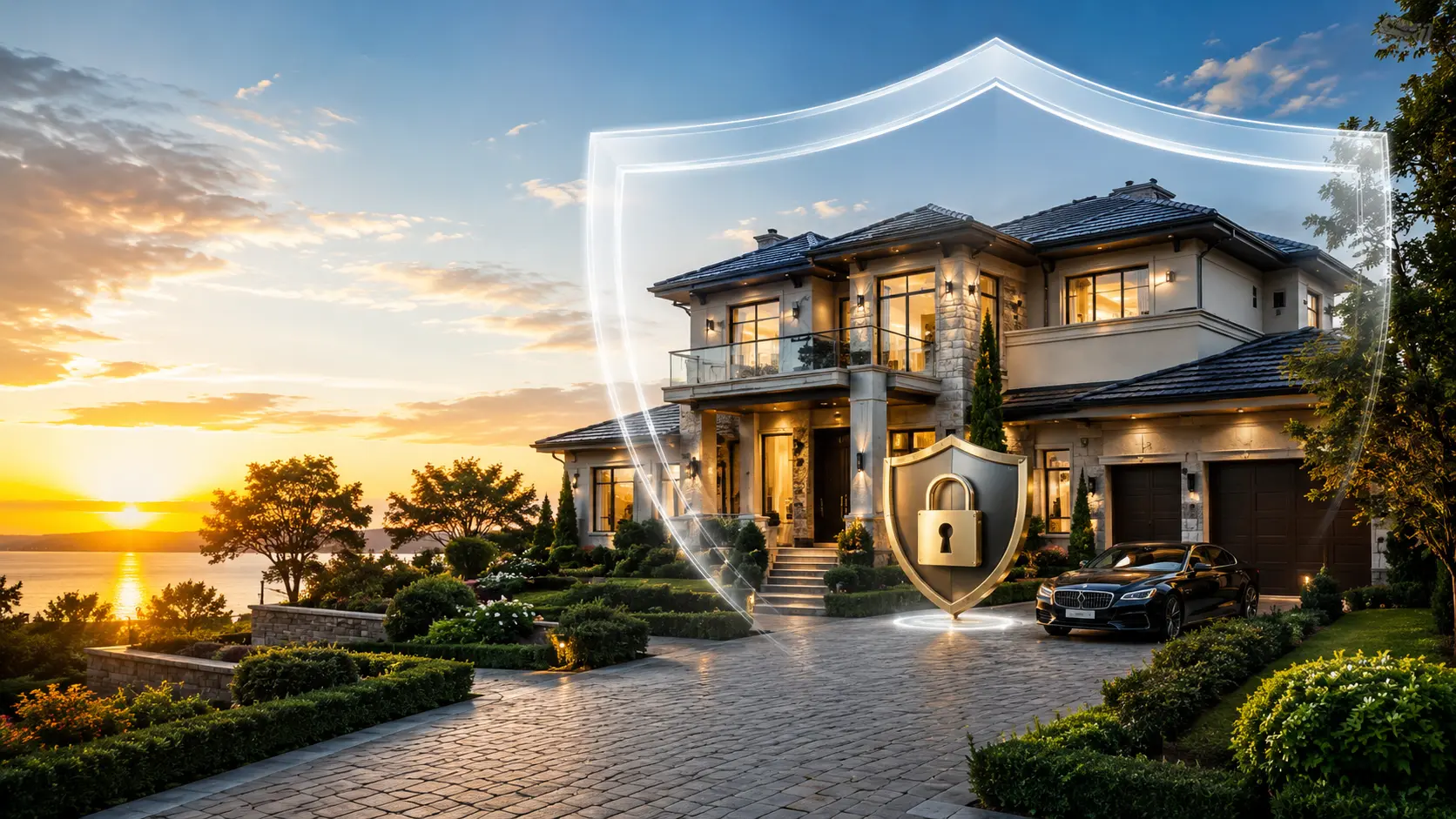
Home insurance for luxury homes is not the same as a standard homeowners policy with a higher price tag. High-value properties often have custom const
Last Updated on June 9, 2026 by Asad Saad
Home insurance for luxury homes is not the same as a standard homeowners policy with a higher price tag. High-value properties often have custom construction, premium materials, art, jewelry, wine collections, smart-home systems, guest houses, pools, and other features that change how a policy should be built. If those details are not insured correctly, the gap can be large when a loss happens. A fire, burst pipe, theft, or liability claim can become much more expensive to resolve on a luxury property than on a typical home.
This guide explains how luxury home coverage works, what makes it different, how insurers price it, and where the common gaps usually appear. You will also learn how to compare quotes, read limits and deductibles, and evaluate claims service before you buy. The goal is to help you choose coverage that matches the real cost of rebuilding and protecting a high-value home, not just a standard policy marketed as “good enough.”
Table of Contents
- What Makes Luxury Home Insurance Different From Standard Homeowners Coverage
- Core Coverage for High-Value Homes: Dwelling, Personal Property, and Liability Limits
- How Insurance Companies Price Luxury Homes: Replacement Cost, Location, Security, and Risk Factors
- Common Gaps in Luxury Home Policies: High-Value Collections, Secondary Homes, and Specialty Endorsements
- How to Compare Luxury Home Insurance Quotes, Deductibles, and Claims Service Before You Buy
What Makes Luxury Home Insurance Different From Standard Homeowners Coverage
Luxury home insurance is built for properties that cost more to rebuild, contain more expensive belongings, or carry more complex risk. A standard homeowners policy often assumes a conventional dwelling, ordinary personal property limits, and modest liability exposure. A high-value home may need broader replacement cost coverage, higher limits, special valuation for contents, and more flexible terms for unique features like custom millwork, designer finishes, and imported materials. In many cases, luxury home insurance is written by insurers that specialize in high-net-worth clients or by standard carriers through an enhanced high-value program.
The biggest difference is not just the price. It is the scope of protection and the way claims are settled. Luxury home policies may offer guaranteed replacement cost or extended replacement cost for the dwelling, agreed value for certain collections, and higher loss-of-use limits if the home becomes uninhabitable. Some policies also include broader coverage for personal liability and risk management services, such as home appraisals or security consultations. For comparison, standard coverage often has tighter sublimits and may be more likely to cap payouts when a loss involves costly items, like fine art or high-end electronics. If you are also reviewing how common home claims are handled, it can help to understand related repair issues such as whether homeowners insurance covers replacing cast iron pipes or when homeowners insurance may cover asbestos removal.
Luxury policies also tend to be more tailored. Insurers may ask for a recent appraisal, a detailed home inventory, and information about security systems, gate access, water shutoff devices, and backup generators. That additional underwriting helps the insurer price the home accurately and decide what endorsements are needed. The drawback is that the process can take longer and documentation demands are usually higher. The benefit is a policy that is much more likely to respond properly after a major claim.
Core Coverage for High-Value Homes: Dwelling, Personal Property, and Liability Limits
The foundation of any luxury home policy is dwelling coverage, which pays to repair or rebuild the structure after a covered loss. For a high-value home, this limit should reflect the true cost to rebuild, not the market value of the house. Those numbers can be very different. Market value includes land and location premiums, while rebuilding cost focuses on labor, materials, permits, and architectural details. If your home has custom stonework, complex rooflines, or imported fixtures, the rebuild cost can be much higher than a standard estimator suggests. A good policy should account for those details through a professional replacement-cost analysis.
Personal property coverage protects your belongings inside the home. On luxury homes, this part deserves close attention because standard policies often have sublimits on jewelry, watches, furs, fine art, collectibles, silverware, and cash. For example, a policy might cover all personal property up to a certain percentage of the dwelling limit, but only pay a small amount for jewelry unless you schedule it separately. Scheduled personal property endorsements let you insure specific items individually, often with broader protection and fewer restrictions. This is especially important if you own designer wardrobes, rare instruments, or collections that would be expensive to replace. The downside is that scheduling items usually requires appraisals and documentation, which adds time and cost.
Liability coverage is equally important because high-value households can create larger legal exposure. Personal liability helps pay if someone is injured on the property or if the homeowner is responsible for damage to someone else’s property. Luxury homes may need higher liability limits than standard policies because they often have pools, guest houses, concierge staff, valuable fixtures, or frequent visitors. Many affluent homeowners also consider a personal umbrella policy to add another layer of protection. That extra coverage is often inexpensive compared with the amount of protection it provides, and it can be useful if a serious claim leads to a lawsuit. Some homeowners also carry higher limits because they host events, employ domestic staff, or own multiple residences, all of which can increase liability risk.
Here is a simple comparison:
| Coverage Type | Standard Homeowners Policy | Luxury Home Policy |
|---|---|---|
| Dwelling limit | Often based on basic rebuild estimate | Based on detailed reconstruction cost |
| Personal property | General limits with sublimits | Higher limits, scheduled items, broader terms |
| Liability | Moderate limits | Higher limits, often paired with umbrella coverage |
| Loss of use | Limited months or percentage | Higher or more flexible living-expense coverage |
| Special items | Tight caps on valuables | Endorsements for collections and high-value belongings |
How Insurance Companies Price Luxury Homes: Replacement Cost, Location, Security, and Risk Factors
Insurers price luxury homes by looking at the cost to rebuild, the likelihood of a claim, and the size of a potential payout. Replacement cost is usually the most important factor. A larger home with premium finishes, custom architecture, and specialty systems costs more to restore after a fire, storm, or water loss. Insurance companies may also consider labor availability in your area, building-code requirements, and whether the house uses unique materials that are harder to source. In some cases, a home with a modest market value can still be expensive to insure because it is costly to reconstruct.
Location also plays a major role. Homes in coastal areas, wildfire zones, earthquake-prone regions, or areas with frequent hail and wind events usually cost more to insure. A luxury home in a high-crime neighborhood may face different pricing pressure than one behind a gated community with monitored access. Even within the same ZIP code, insurers can price differently based on proximity to fire stations, hydrants, and emergency services. If you own a second home in a coastal or mountain area, location risk can become even more important because occupancy patterns and weather exposure may differ from your primary residence.
Security and loss-prevention features can help lower risk, though not always dramatically. Monitored alarms, smart water sensors, automatic shutoff valves, safe rooms, impact-resistant roofing, and professional security systems can make a property more attractive to insurers. Some carriers also consider whether the home is occupied year-round, whether it has a full-time caretaker, and how often it is vacant. Vacant or intermittently occupied luxury homes often cost more to insure because losses may go unnoticed for longer. That is also why some owners choose specialized coverage for second homes, which can be different from primary-residence policies. In high-value neighborhoods, insurers may be particularly attentive to theft and water damage because those losses can be expensive and difficult to detect early.
Pricing also depends on your claims history, credit-based insurance score where allowed, deductible choice, and whether you bundle home and auto insurance. A higher deductible can reduce premiums, but it means you pay more out of pocket after a claim. That tradeoff matters more on luxury homes because repairs can be expensive and large deductibles can become significant. Some homeowners prefer to pay more in premium for lower out-of-pocket risk, especially if they expect to file a claim only rarely. Others choose a higher deductible to keep annual costs manageable. The right answer depends on cash flow, risk tolerance, and how much volatility you are willing to accept.
Common Gaps in Luxury Home Policies: High-Value Collections, Secondary Homes, and Specialty Endorsements
One of the most common mistakes luxury homeowners make is assuming the base policy fully covers high-value items. It usually does not. Jewelry, watches, fine art, antiques, rare books, collectibles, wine, luxury handbags, and designer clothing often have sublimits or exclusions. For example, a standard policy might insure jewelry only up to a relatively small amount unless the pieces are individually scheduled. Fine art may require a separate appraisal and a special form of coverage that reflects its agreed value rather than depreciated worth. If your policy does not specify these details, a claim can be settled for far less than expected.
Secondary homes can also create coverage gaps. A beach house, ski cabin, or guest cottage may not qualify for the same terms as a primary residence. Insurers may apply different underwriting rules if the property is vacant for long periods or exposed to a different set of risks. Water damage, freeze loss, storm surge, theft, and vandalism are common concerns in vacation properties. Some owners assume their main residence policy extends seamlessly to all homes, but that is rarely true. Each property may need its own policy or a carefully structured multi-residence arrangement. The same is true for renters or owners in luxury towers, where specialized condo or high-value renters coverage may be more appropriate than a standard homeowner form.
Specialty endorsements are how many of these gaps get filled. An endorsement is an add-on that changes or broadens the policy. Common examples include scheduled personal property, water backup coverage, ordinance or law coverage, equipment breakdown, identity theft protection, and enhanced replacement cost coverage. For luxury homes, these endorsements can be essential rather than optional. A home elevator, wine cellar, home theater, or solar system may need specific treatment. Some endorsements are relatively affordable, while others can add meaningful cost depending on the home and the insurer. The alternative is to self-insure the gap, which may work for very wealthy households but is risky for most buyers. If a claim involves a guest accident or lawsuit, it can also help to understand how liability behaves in other settings, such as car insurance accidents on private property, because property-related liability questions often overlap.
Another overlooked gap is how insurers value damaged contents. Some policies pay actual cash value, which subtracts depreciation, while others pay replacement cost. On luxury items, the difference can be substantial. A five-year-old designer sofa or high-end television may be worth far less under actual cash value, even though replacing it costs much more today. That is why many luxury homeowners review valuation rules item by item rather than assuming every loss will be covered at full replacement cost.
How to Compare Luxury Home Insurance Quotes, Deductibles, and Claims Service Before You Buy
When comparing luxury home insurance quotes, do not focus only on the premium. Start by comparing the dwelling limit, personal property limits, liability limits, deductibles, and endorsements. Then look closely at how each insurer handles replacement cost, scheduled items, and water damage. Ask whether the policy includes guaranteed replacement cost, extended replacement cost, or a hard cap on reconstruction payments. Also confirm whether the insurer will assign a dedicated high-value claims team, because service quality matters more when the loss is complex. A cheap policy that settles slowly or narrowly can be far more expensive in practice.
Deductibles deserve special attention because they can be structured in different ways. Some policies use a flat dollar deductible, while others apply a percentage deductible for wind, hurricane, or earthquake losses. On a luxury home, a percentage deductible can become very large if it is based on the dwelling limit. That may be fine for a homeowner with strong reserves, but it can create serious cash-flow stress after a storm. It is wise to compare not just the deductible amount, but also how it applies by peril. For example, a policy may have one deductible for most claims and a separate, higher deductible for coastal wind damage. If your property is in a high-risk area, that detail matters as much as the premium.
Claims service is often the difference between a tolerable claim and a frustrating one. Ask whether the insurer offers in-house adjusters or uses more outside contractors. Read customer feedback carefully, especially on large-loss handling, communication, and settlement speed. Financial strength ratings from agencies such as A.M. Best, Moody’s, or Standard & Poor’s also matter because they help signal whether the company can pay large claims reliably. Strong ratings do not guarantee a smooth claim, but weak ratings are a warning sign for high-value property insurance. If a claim dispute ever arises, it can also be useful to know about settlement support options such as mediation for insurance settlements or how adjusters evaluate damage in contested claims, like when an insurance adjuster says there is no hail damage.
Before buying, compare at least three quotes and ask each carrier the same questions:
- What is the dwelling limit based on?
- Does the policy include guaranteed or extended replacement cost?
- Are jewelry, art, and collectibles covered automatically or only by endorsement?
- Are water backup, equipment breakdown, and ordinance or law included?
- Are there separate wind, hurricane, or earthquake deductibles?
- How does the insurer handle temporary living expenses after a major loss?
- Will I have a dedicated high-value claims specialist?
Luxury home insurance is not just about protecting an expensive address. It is about making sure the policy matches the true cost of rebuilding the home, replacing the contents, and handling the legal and financial exposure that comes with owning a valuable property. The best policy is usually the one that balances strong limits, clear endorsements, and reliable claims service at a price that fits your risk tolerance. For many homeowners, that means paying a bit more for broader protection and better service rather than settling for a standard policy that looks similar on paper but falls short when it matters.
Home insurance for luxury homes works best when it is tailored, not generalized. High-value properties need accurate rebuild estimates, stronger personal property protection, and liability limits that reflect real-world exposure. They also need careful attention to endorsements, because many costly items and property features are not fully covered by a standard policy.
If you own a luxury home, the smartest approach is to compare coverage details as closely as you compare price. Look at replacement cost terms, deductibles, exclusions, and claims reputation before deciding. The right policy should protect the full value of the home and give you confidence that a major claim will be handled properly.

COMMENTS