
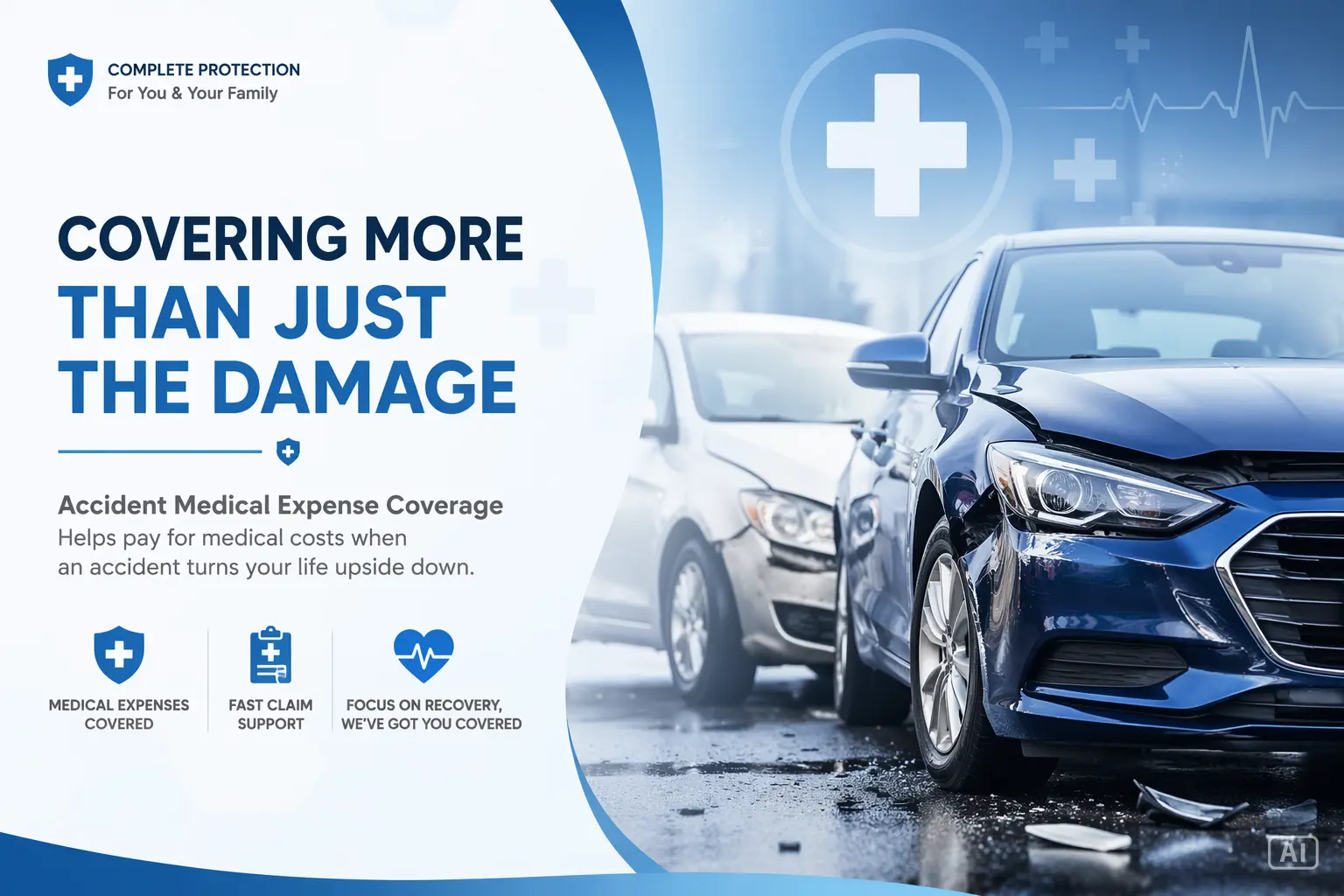
Medical payments coverage, often called Med Pay, is one of those auto insurance features people rarely think about until they need it.
Last Updated on June 7, 2026 by Asad Saad
Medical payments coverage, often called Med Pay, is one of those auto insurance features people rarely think about until they need it. When an accident happens, the medical bills can arrive fast, even for injuries that seem minor at first. Understanding Medical Payments Coverage Explained helps you see how this coverage can pay for treatment, who it protects, and where it fits alongside health insurance, Personal Injury Protection, and liability coverage.
At a basic level, Med Pay is optional auto insurance that helps pay medical expenses for you and your passengers after a covered accident, no matter who caused the crash. It is designed to be simple and quick to use, which is why many drivers value it as an added financial cushion. In this guide, you’ll learn what Med Pay covers, how claims work, what it costs, its limits and exclusions, and when it makes sense to choose it over other options.
Table of Contents
- What Medical Payments Coverage Is and What It Covers
- How Medical Payments Coverage Works After an Accident
- Medical Payments Coverage Costs, Limits, and Deductibles
- Key Benefits, Exclusions, and Common Limitations of Med Pay
- When Medical Payments Coverage Makes Sense and How It Compares With PIP and Health Insurance
What Medical Payments Coverage Is and What It Covers
Medical payments coverage is an auto insurance add-on that pays for certain medical costs resulting from a car accident. It usually covers the policyholder, family members in the household, and passengers in the insured vehicle, depending on the policy language. Unlike liability insurance, which pays for other people’s injuries when you are at fault, Med Pay can help cover your own medical bills regardless of who caused the accident. In plain English, it is a “first-dollar” benefit for accident-related medical expenses, meaning it can start paying before a health plan deductible is met.
Med Pay typically covers reasonable and necessary medical treatment such as emergency room visits, ambulance transport, surgery, X-rays, hospital stays, doctor appointments, chiropractic care, and physical therapy. It may also cover funeral expenses in fatal accidents, depending on the policy. Coverage is usually limited to injuries sustained in a motor vehicle accident, though some policies extend to injuries involving you as a pedestrian or while riding in someone else’s car. If you want to understand how this kind of protection differs from other coverage tied to vehicle damage or property-related claims, you may also find it useful to review whether car insurance covers accidents on private property.
A simple example helps. Suppose you are rear-ended at a stoplight and you, your spouse, and a friend in your car all need medical evaluation. If your policy includes Med Pay, it may help pay each person’s eligible accident-related medical bills up to the policy limit, even if the other driver caused the crash. That makes it especially helpful for quick medical treatment after a minor or moderate accident, when waiting for fault determination or settlement could delay reimbursement.
How Medical Payments Coverage Works After an Accident
After a covered accident, Med Pay is usually straightforward to use. You seek medical treatment, keep your bills and records, and submit a claim to your auto insurer. Because Med Pay does not depend on fault, you do not have to wait for the insurance company to decide which driver caused the crash before using the coverage. That speed is one of its biggest practical advantages, especially when you need help paying urgent bills such as ambulance fees or an initial ER visit.
In most cases, the insurer will review the treatment records to confirm that the expenses are related to the accident and fall within the policy terms. Once approved, Med Pay can reimburse you directly or pay providers, depending on how the claim is handled. If another driver is later found liable, your insurer may seek repayment from that driver’s insurer through subrogation, but that back-end process usually does not affect your initial access to benefits. This is different from claims that involve property damage disputes, where fault and valuation can create delays and disagreement, such as in cases where an adjuster denies visible damage like an insurance adjuster saying there’s no hail damage.
It is also important to know that Med Pay is not a substitute for every medical cost you may face after a crash. It only pays up to the policy limit, and that limit may be relatively small. If your medical bills are higher than your Med Pay limit, you would need to turn to health insurance, another auto-related coverage such as PIP if available, or the at-fault party’s insurance. For example, if you have $5,000 in Med Pay and your treatment costs total $12,000, Med Pay can help with the first $5,000, but you would still need another source of payment for the remaining balance.
Medical Payments Coverage Costs, Limits, and Deductibles
Medical payments coverage is usually inexpensive compared with other auto insurance coverages. Many drivers can add it for a modest increase in premium, often because the insurer is covering only a limited amount of medical expense and only for accident-related injuries. The exact price depends on factors such as your state, insurer, vehicle use, driving history, and chosen limit. A driver who commutes daily in a busy metro area may pay more than a low-mileage driver in a less congested region, but Med Pay generally remains one of the more affordable policy add-ons.
Most policies offer limits in small increments, commonly from $1,000 to $10,000, though higher limits may be available in some states or with certain carriers. The limit is the maximum amount Med Pay will pay per person or per accident, depending on how the policy is written. One major benefit is that Med Pay typically has no deductible, which means benefits can begin without you paying a set amount out of pocket first. That can be helpful if you want immediate help with bills rather than waiting for a deductible to be met, as you might with some health insurance plans.
Here is a quick comparison of common Med Pay features:
| Feature | Typical Med Pay Treatment |
|---|---|
| Monthly or annual cost | Usually low |
| Deductible | Often none |
| Coverage limit | Commonly $1,000 to $10,000 |
| Fault required? | No |
| Primary purpose | Accident-related medical bills |
| Works with health insurance? | Yes, often as a supplement |
If you are deciding how much coverage to buy, think about your health insurance deductible, your savings, and how many passengers you regularly carry. A higher Med Pay limit can make sense if you often drive with family members, carpool, or live in a state where medical cost exposure after a crash can rise quickly. On the other hand, if you already have robust health coverage and very low accident exposure, a lower Med Pay limit may be enough. People shopping for broader personal protection may also want to compare it with other coverage options, including policies that support longer-term planning like over-50 life insurance for added peace of mind, though that serves a very different purpose.
Key Benefits, Exclusions, and Common Limitations of Med Pay
The biggest advantage of Med Pay is simplicity. It can help pay accident-related medical costs quickly, without needing a fault determination or a lengthy claims dispute. That can reduce stress in the first days after a collision, when medical appointments, prescription costs, and transportation expenses may pile up. It is also useful for passengers, since many passengers do not have immediate access to auto-related medical coverage of their own. For households that regularly transport children, relatives, or friends, Med Pay adds a practical layer of protection.
Another benefit is that Med Pay can complement health insurance. If your health plan has a high deductible, Med Pay can help fill the gap and reduce your out-of-pocket burden. In some cases, it can also help pay costs that health insurance may not fully cover, such as ambulance coinsurance or certain copayments. That said, this coverage is not designed to pay for everything, and it should not be viewed as a replacement for health insurance or as a broad injury protection plan.
Common exclusions and limitations usually include:
- Injuries not caused by a covered auto accident
- Expenses beyond the policy limit
- Treatment that is not medically necessary
- Injuries from intentional acts or certain illegal activities
- Costs already paid or excluded under specific policy terms
- Some long-term care or non-accident-related rehabilitation expenses
Limitations vary by insurer and state, so reading the policy is important. Med Pay also does not cover vehicle repairs, lost wages, or pain and suffering. If your goal is broader injury protection, you may want to compare Med Pay with Personal Injury Protection, which can include additional benefits in some states. And if your injury occurs in a home-related incident rather than a car crash, you would generally look to homeowners or renters coverage instead. For example, home-related repair and damage issues are handled under a different policy framework, such as homeowners insurance coverage for replacing cast iron pipes, not auto medical payments.
When Medical Payments Coverage Makes Sense and How It Compares With PIP and Health Insurance
Medical payments coverage makes the most sense for drivers who want affordable, no-fault medical help after a crash. It is especially appealing if you carry passengers often, have a high-deductible health plan, or live in a state where PIP is not required or not available. It can also be a smart choice for people who want a simple backup source of payment for emergency care without adding much to their premium. If your budget is tight but you want some extra protection against medical bills, Med Pay is often one of the easiest coverages to justify.
Whether you should choose Med Pay over PIP or rely mainly on health insurance depends on how much protection you need and what your state allows. Personal Injury Protection is broader in many states because it may cover medical bills, lost wages, and other accident-related costs. Health insurance can cover a much wider range of medical situations, but it usually involves networks, deductibles, copays, and preauthorization rules. Med Pay is narrower than both, but it can be faster and simpler. Here is a practical comparison:
| Coverage Type | Main Purpose | Covers Lost Wages? | Deductible? | Fault-Based? | Best For |
|---|---|---|---|---|---|
| Medical Payments Coverage | Accident-related medical bills | No | Usually no | No | Drivers who want low-cost medical backup |
| PIP | Broader accident injury benefits | Often yes | Sometimes | No | Drivers in PIP states who want more comprehensive protection |
| Health Insurance | General medical care | No | Usually yes | No | Ongoing medical treatment and broader healthcare needs |
In real life, many households use Med Pay as a supplement, not a standalone solution. For example, if you are in a minor crash and need an ER visit plus follow-up care, Med Pay may handle part of the bill quickly while health insurance covers the rest under normal medical plan rules. If you live in a state with PIP, compare the benefits carefully because PIP may offer more value if you want wage replacement or broader injury coverage. If you have excellent health insurance and a strong emergency fund, you may choose a lower Med Pay limit or skip it entirely. But if you want a low-cost cushion that helps with immediate medical bills after an auto accident, Med Pay is often worth considering.
Medical payments coverage is a small but useful part of an auto insurance policy. It helps pay accident-related medical expenses quickly, usually without a deductible and without waiting to assign fault. For many drivers, that makes Med Pay a practical safety net, especially when health insurance deductibles are high or when passengers may need treatment after a crash.
The right choice depends on your budget, your health insurance, and the level of protection you want after an accident. Med Pay is not the broadest coverage available, but it can be an efficient and affordable way to reduce out-of-pocket medical costs. If you understand its limits and compare it with PIP and health insurance, you can decide whether it belongs in your auto policy.

COMMENTS